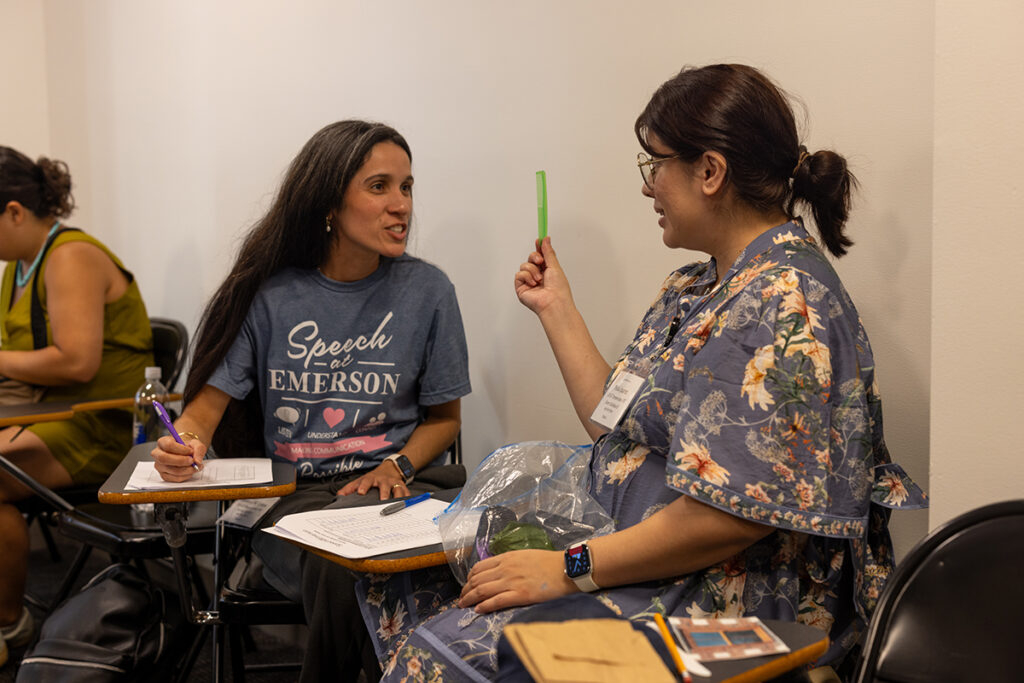
On a recent Friday, dozens of Emerson College students gathered in a classroom in the former Union Bank Building and pretended to be 5 years old. Divided into pairs, half the class selected items at random out of a cardboard box — shoes, plastic rings, leaves, photographs — and intentionally mispronounced the name of the objects they were holding.
The exercise wasn’t part of an acting class or play rehearsal, but rather a preschool screening lab within Immersion, a three-day seminar held by Speech@Emerson, Emerson’s online Master’s program in speech pathology. On Thursday, August 13, 60 students traveled to campus from around the country to attend the mandatory conference, which offers hands-on practice of the clinical skills they’ve been learning online.
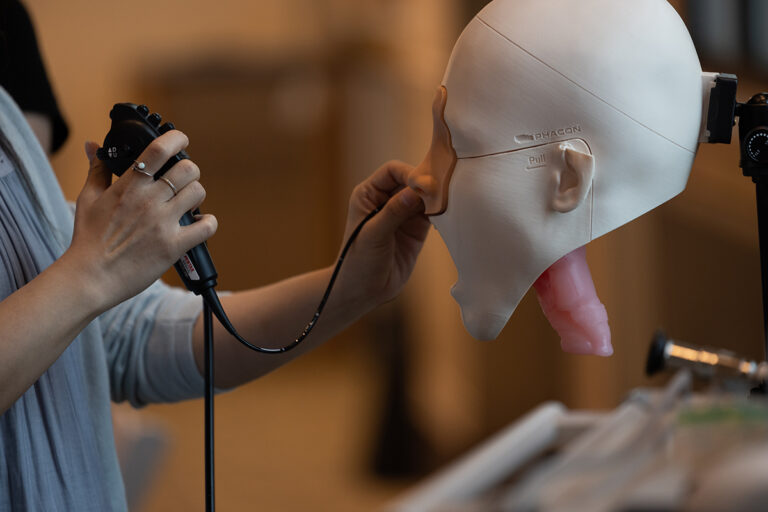
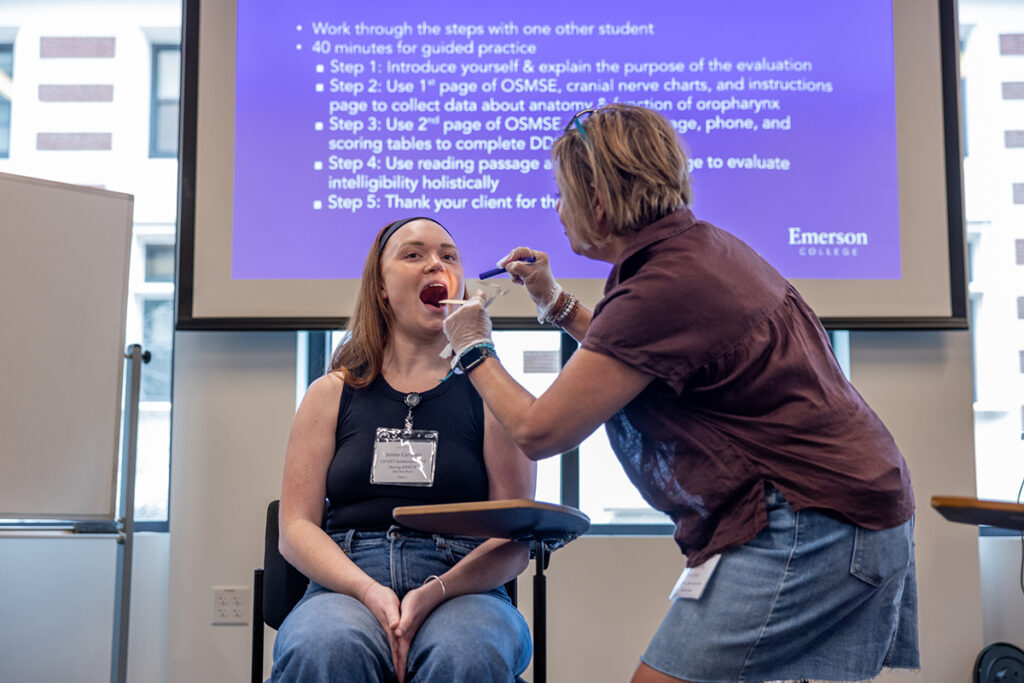
Immersion participants had a full schedule from Thursday to Sunday, with some sessions covering practical topics like how to secure clinical placements, implement research, and perform clinical laryngoscopies. Others covered more cultural topics like Deaf culture and American Sign Language in the field of speech language pathology, and working with multilingual clients.
The preschool screening lab was designed to mimic a real-life assessment of preschoolers, allowing students to practice giving the test to potential future clients. Affiliated faculty member Deb Orlofsky, a practicing speech language pathologist, facilitated Friday’s session and said she looks forward to Immersion every year.
“I love Immersion, it fills my cup,” she said, “…it’s just so nice to see my students live, run the labs, and have them apply all of their learning from the semester and have it meld together.”
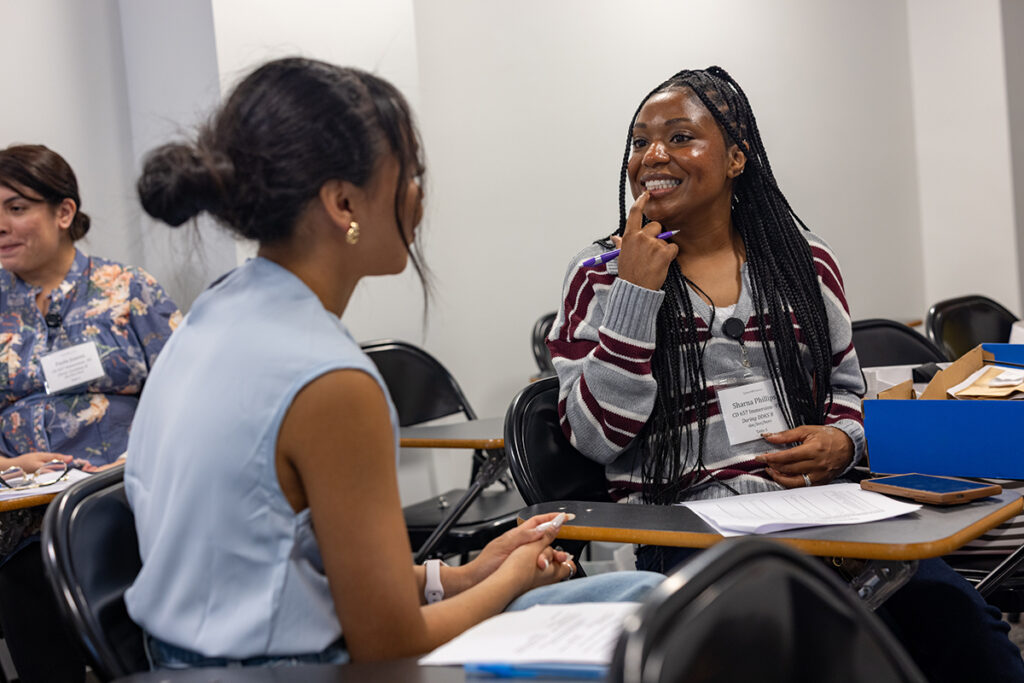
During the lab, she encourages students to throw their practice partners behavioral curveballs so that they can practice how to respond to unpredictable situations in the field, whether they come from toddlers or their parents. The practice will soon be put to good use; the semester after Immersion, students begin their clinical placements.
“It really gives them a confidence boost,” Orlofksy said.
After obtaining an MS in Communication Disorders from Emerson, Speech@Emerson students can go on to work as speech pathologists with a diverse range of client populations and in many settings, including schools, hospitals, or private practice. The program gives students generalist clinical training, giving them a wide range of placement options post-graduation.
Launched in 2018, Speech@Emerson has since graduated more than 1,000 SLPs. Approximately half of its student population are people of color, said Kate Roberts, associate director of academic planning and operations in Emerson’s Department of Communication Sciences and Disorders, in stark contrast to the demographics of the broader field, which is 92 percent white. “We pretty much single handedly helped move the needle on the percentage of diverse SLPs working across the country,” she said.
Just as students choose a variety of settings to work in as speech language pathologists after graduation, their reasons for pursuing a degree in the specialty are just as varied. As an employee of a Boston rehabilitation hospital, Katlyn Robillard ‘28 said she knew Emerson had a reputation for producing great speech language pathologists and wanted to become one of them.
“I’ve gotten to see all the amazing work that the SLPs do at our rehab hospital in helping people get better, gain more independence, and I wanted to be part of that,” she said.
For Frances Takemoto, who traveled to Immersion from Nashville, TN, her ultimate goal is to work with multilingual clients. “Specifically [working with] Japanese speaking clients would be a dream of mine,” she said, “I speak Japanese, I taught in Japan, and I think it would be really great to connect with those families to help them feel understood.”
New Jersey resident Ioanna Tsakalaos, a trained opera singer, said her own experience receiving voice therapy from an SLP made her want to pursue a career helping other singers rehabilitate their voices. “[At] the last job I had as a vocal music teacher, one of the speech teachers was from Emerson,” she said. “She was so amazing that I was like, OK, now I know I want to do Speech@Emerson.”
Emerson’s SLP program also covers the many different ways people can communicate beyond speech and language, such as facial expressions, American Sign Language, and augmentative and alternative communication. The opportunity to offer clients interventions to improve their communication abilities was what inspired Florida resident Haley Tennee Workinger to want to become a speech language pathologist. A former character actor at Walt Disney World and an avid Disney fan, Workinger drew a connection between both of her passions when speaking about her SLP education.
“Ariel is my favorite princess, and she doesn’t even talk for most of [The Little Mermaid],” she said, “…Ariel did not have an AAC device, but if she did, she probably would’ve had a better experience.”
Despite their different backgrounds and ambitions, however, nearly all of the students cited the convenience of Speech@Emerson’s completely online format as a major reason they chose it for their studies. The Immersion program allows those students an opportunity to connect in real life, and practice hands-on the skills they’ve learned online.
Watching students become more confident in their abilities, Roberts said, is a hallmark of the Immersion experience for her. “It’s ensuring that they’re ready for those next steps, but they also need to realize it for themselves,” she said. “They come in on day one worried saying ‘I can’t do this,’ and by the time they leave, they’re like, ‘oh, I’m totally ready for this.’”