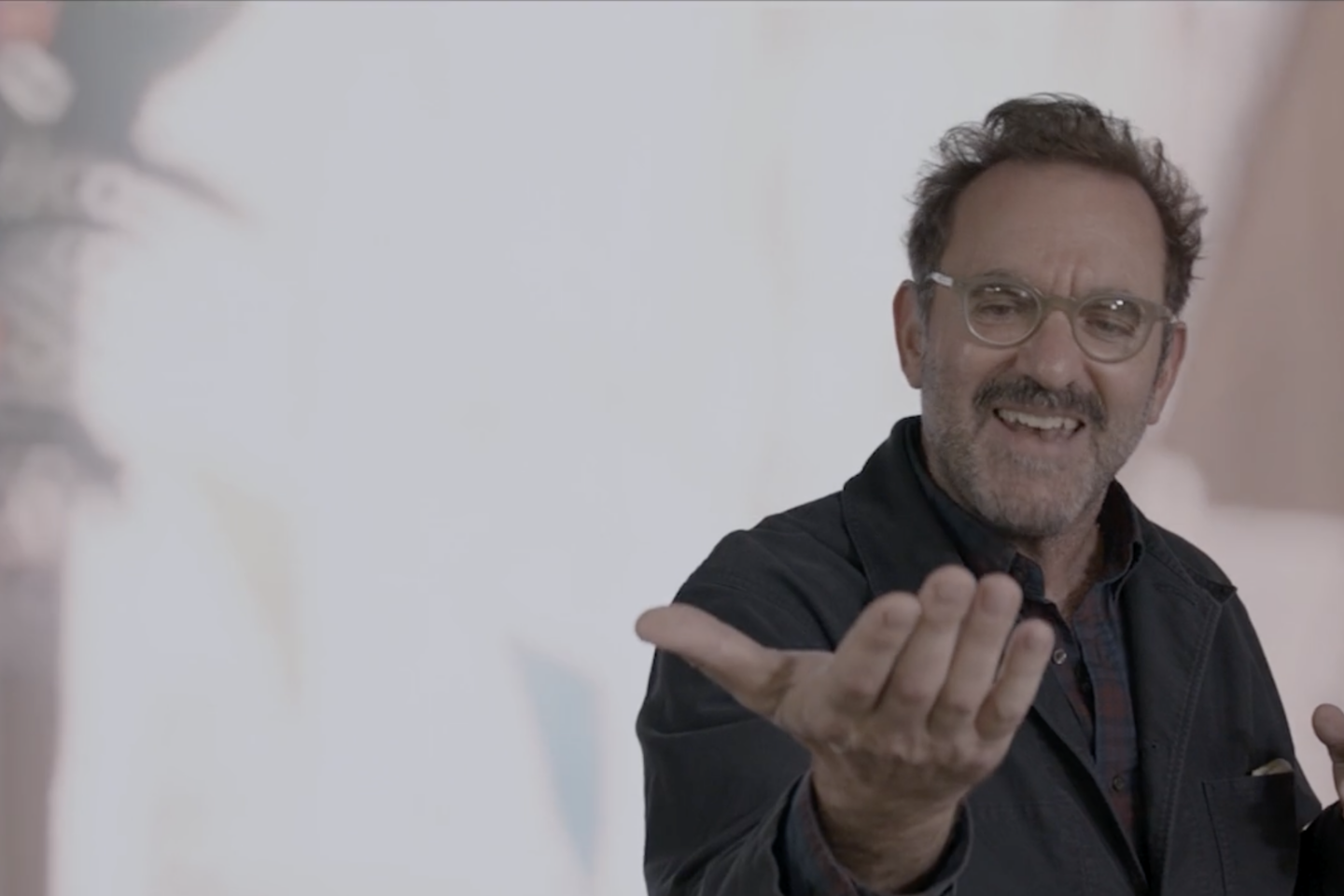
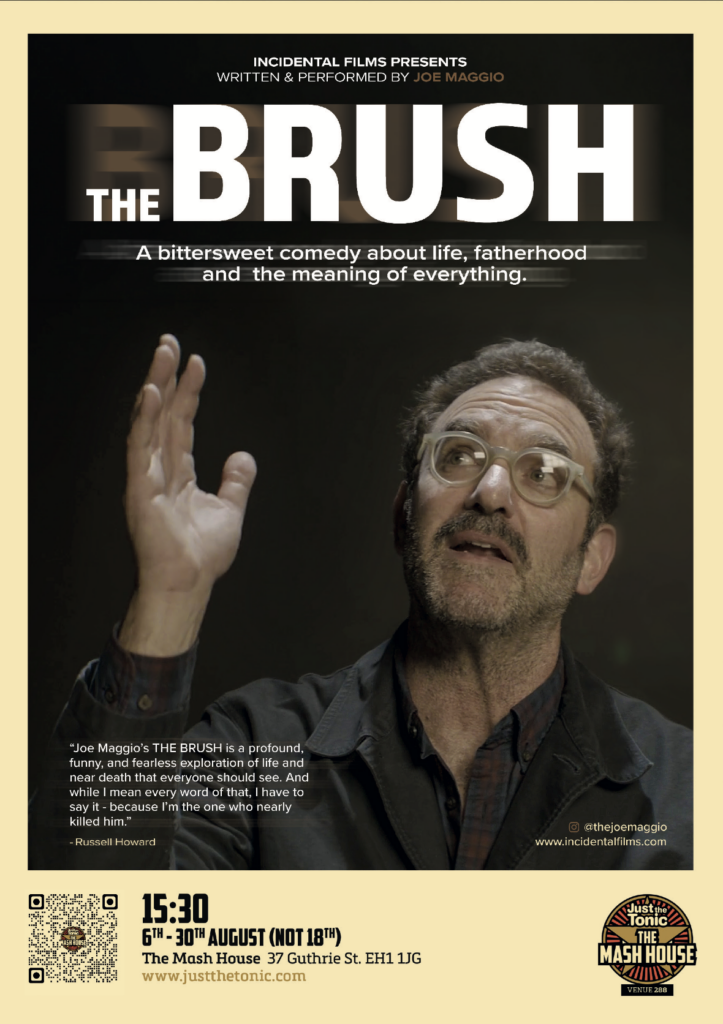
For 24 days this summer, School of Film, Television, and Media Arts Associate Professor Joseph Maggio stepped onto a stage at the Edinburgh Festival Fringe to tell the story of an injury he sustained while playing in a bachelor party soccer game that nearly cost him his life.
Maggio turned that experience—in which doctors offered him a priest to discuss his end-of-life rites—into a one-man show, The Brush.
Thankfully, he only experienced that brush with death once, but the show was never exactly the same twice.
“I change it every day,” said Maggio. “That’s the beauty of the Fringe.”
For Maggio, the Edinburgh experience was more than an opportunity to perform at one of the world’s most renowned performing arts festivals. It was an intensive lesson in storytelling—one that he can now bring directly into his Emerson classrooms.
Things that worked on paper did not necessarily work in front of a live audience. A joke might need another beat. A line might be unnecessary. A passage might be too long. Something that seemed perfectly clear during rehearsal might leave an audience behind.
“You can almost feel them leaning forward a little bit,” Maggio said. “And you feel like you’re pulling them along. That’s the important stuff.”
That ability to sense an audience’s response was one of the skills Maggio said he developed during his Fringe run. And it gave him an experience that is difficult to replicate without actually standing onstage: the chance to test a story, adjust it, and immediately discover whether the change works.
A Story About Chance
Maggio’s brush with death began during a British bachelor party—or “stag do”—in Las Vegas.
Maggio had met British comedian Russell Howard while working as a sound recordist on a television shoot in New York in 2016. Maggio had not even been scheduled to work that day, but he was asked to fill in for a sound recordist who had called in sick.
During lunch, Maggio and Howard began talking. It happened to be the summer of 2016, when Brexit and the rise of Donald Trump were major topics of conversation, and Maggio was the only American on the British crew.
Following that conversation, Maggio was asked to join the production for its East Coast leg. Then the West Coast. Eventually, he traveled around the world with the crew.
Years later, Maggio learned that the sound recordist he had replaced had not actually remained sick. Howard had enjoyed Maggio’s company so much that he had asked the production to buy out the other sound recordist’s contract.
An Unexpected Chain of Events
It eventually led Maggio to Howard’s stag do, where Maggio injured his knee playing soccer.
“I tried to stop a ball, the ball hit my leg, and I turned. I heard the ripping sound, and my leg was destroyed,” Maggio said.
He kept playing.
During the next few days, his friends carried him around. After returning to New York, however, Maggio knew something was wrong. He went to the hospital and learned a blood clot had formed and had traveled to his lung, causing a pulmonary embolism.
For a period of time, Maggio and his wife were essentially waiting to find out whether his heart would go on or stop.
“They just have to wait, and either your heart will hold up or not,” he said. “And that was basically where a lot of The Brush takes place.”
The experience could have become a straightforward story about a medical emergency. Instead, Maggio uses it to explore chance, mortality, faith, healthcare, and the strange collection of decisions and coincidences that can shape a life.
The experience helped push Maggio toward performing live and doing stand-up. He began performing alongside Howard when the comedian toured the United States, eventually developing those experiences into The Brush.

The show draws inspiration from the one-person monologues of Spalding Gray, whose work Maggio admired for its ability to weave multiple timelines and ideas into a central narrative.
Maggio’s Edinburgh performance was intentionally spare: one performer telling one story directly to an audience.
But he has bigger plans for The Brush.
The next version will incorporate multimedia elements, including a large video screen, projected video and still images, lighting cues, a score, and sound effects. Maggio envisions a performance that uses virtual-production technology to transport the audience into different environments while he remains onstage.
He also plans to create a film version of the show.
“The hard part’s done,” he said. “I’d say I’m about three quarters of the way through.”
Learning by Doing
Maggio’s experience with The Brush has also reinforced something he already brings into his teaching: storytelling is fundamentally about communication.
“Lecturing is very performative,” he said. “I’m trying to communicate with the students.”
He said that is not so different from performing a monologue or doing stand-up.
“You’re trying to communicate an idea that is going to make the audience sit up and think, or laugh, or lean into you, so that you have their attention, so that you can actually plant the seed of something in their brain,” Maggio said.
His years teaching at Emerson have helped him become comfortable in front of a classroom. But performing The Brush gave him another perspective: what it feels like to be the person taking a creative risk in front of an audience.
That experience matters, he said, particularly for students preparing to enter a rapidly changing filmmaking and storytelling landscape.
“What is the future of film? What is the future of storytelling?” Maggio asked. “What can we do with these technologies?”
Artificial intelligence, virtual production, and other emerging technologies are changing how stories can be created and experienced. For Maggio, that makes curiosity and experimentation more important, not less.
In Edinburgh, Maggio learned something that can only be learned by stepping in front of an audience: a story is never truly finished when it leaves the page. It changes when another person hears it. Bringing those lessons back to Emerson, Maggio wants students to think not only about the stories they create, but also about the ways they can tell them.
The lesson is one Maggio is continuing to learn himself.
“I’m still finding my way,” he said. “I’m still trying things out. I’m happy being a novice, and trying things out for the first time, and sometimes failing.”