Welcome to the world of vertical microdramas. The titles are big, the episodes are small, and the next cliffhanger is just a swipe away. These bite-sized scripted series pack romance, revenge, and plot twists into episodes designed for the phone screen. Millions of viewers are tuning in, drawing increasing attention from Hollywood.
“More people watched the vertical that I did last month than the new Steven Spielberg movie [Disclosure Day]. That’s crazy to think about,” said Michael Reich ’03, a director, producer, and cinematographer. “It’s so easy to pick up your phone and watch. Once you start, you keep going to get that dopamine rush.”
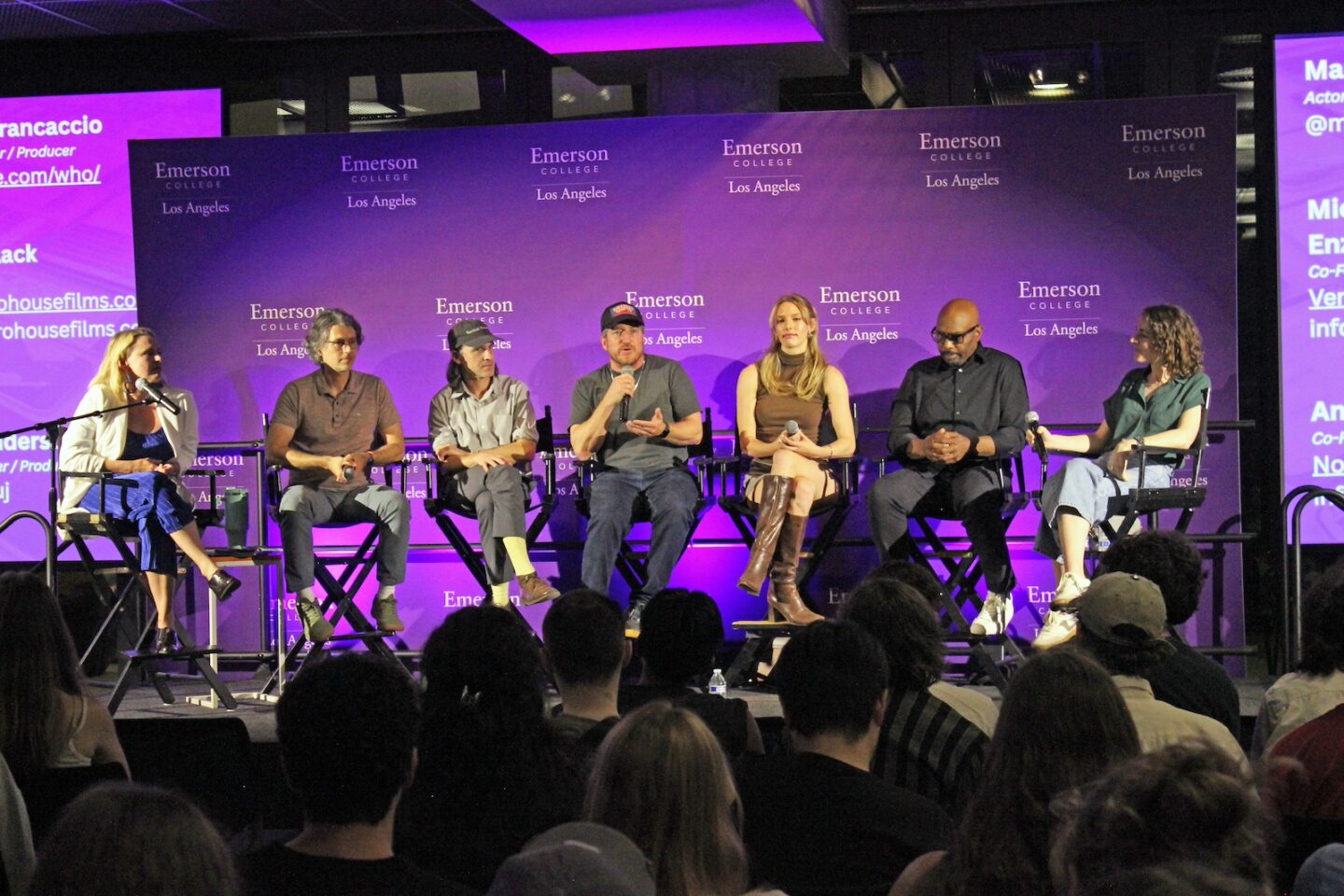
Reich, who co-founded Vertical Romance with veteran filmmaker and fellow Emersonian Enzo Semmens ’02, spoke about working in the verticals space during a panel on September 3 at Emerson Los Angeles. Reich was joined by Semmens; Anthony Baldino ’03, producer and co-founder of Normal TV; James Black, co-founder of Microhouse Films; Molly Anderson, actress, writer, and producer; Kristen Brancaccio, a writer and director of more than 20 verticals; and moderator Marie Lively ’04, an actor, producer, casting director, and host of the podcast Micro Drama Doses.
Reich got his start with verticals when he received an unsolicited email from a Chinese company asking him to direct one. At first, he thought it was spam. But after working on a few microdramas and falling in love with the format, he brought Semmens aboard.
“We felt like we were really poised to succeed in the space because of our background,” said Semmens. “From the speed of working on music video productions, the challenges with low-budget indie narrative filmmaking, and also the structure of commercial filmmaking where you have to deal a lot with client notes—that’s the intersection of where verticals are.”
Several years ago, duanju, the Chinese term for microdramas, surged in popularity. As Hollywood took notice, microdramas opened up opportunities for creatives. Now, celebrities like Kevin Hart and Taye Diggs are getting in the field.
“I call it actors bootcamp or writers bootcamp. It’s one of those industries where you can get your 10,000 hours quickly,” said Lively, who reviews microdrama episodes each week on her podcast.
That accelerated pace is one of the defining characteristics of the format, as a project can go from action to delivery in roughly two months.
The speed of production carries over to the set. Reich said a vertical set shoots a minimum of 12 pages a day, with an average of about 15, compared to roughly five pages for a traditional TV series. For filmmakers and actors on a vertical, that means everyone has to bring their A-game.
“I got the BFA. I’ve done classes since I was a kid. Nothing has ever trained me as well as verticals. That one take is not a joke,” said Anderson. “That’s what’s going out there for hundreds of millions of people to see. It’s sink or swim. You lock in or you don’t. You learn really quickly, can you bring it?”
With the fast pace of production and the demand for content, microdramas are a space especially ripe for recent Emerson graduates.
“Right now, you can go write a vertical script if you understand the format. You can sell it. You’re not gonna get paid a ton of money, but… guess what? You just sold a script. Guess what? Chances are it’s going to get made unlike selling scripts in traditional Hollywood. You can have something that’s a tangible, final product that you can say, ‘I got paid to do what I went to school for,'” said Semmens, who authored The Microdrama Blueprint Hollywood Hates. “I think that’s really beautiful.”
That kind of advice is what Semmens has shared with his Emerson interns, including Bethany Loach ’26 and Reagan Sissel ’26, who interned at Vertical Romance during the Spring 2026 semester, along with Yijia Chen ’26 and ELA student Jame Riera Salicrú.
Right now, you can go write a vertical script if you understand the format…You can have something that’s a tangible, final product that you can say, ‘I got paid to do what I went to school for.’
Enzo Semmens '02
“I got the BFA. I’ve done classes since I was a kid. Nothing has ever trained me as well as verticals. That one take is not a joke,” said Anderson. “That’s what’s going out there for hundreds of millions of people to see. It’s sink or swim. You lock in or you don’t. You learn really quickly [if] you can bring it.”
With the fast pace of production and the demand for content, microdramas are a space especially ripe for recent Emerson graduates.
“Right now, you can go write a vertical script if you understand the format. You can sell it. You’re not gonna get paid a ton of money, but… guess what? You just sold a script. Guess what? Chances are it’s going to get made unlike selling scripts in traditional Hollywood. You can have something that’s a tangible, final product that you can say, ‘I got paid to do what I went to school for,'” said Semmens, who authored The Microdrama Blueprint Hollywood Hates. “I think that’s really beautiful.”
That kind of advice is what Semmens has shared with his Emerson interns, including Bethany Loach ’26 and Reagan Sissel ’26, who interned at Vertical Romance during the Spring 2026 semester, along with Yijia Chen ’26 and ELA student Jame Riera Salicrú.
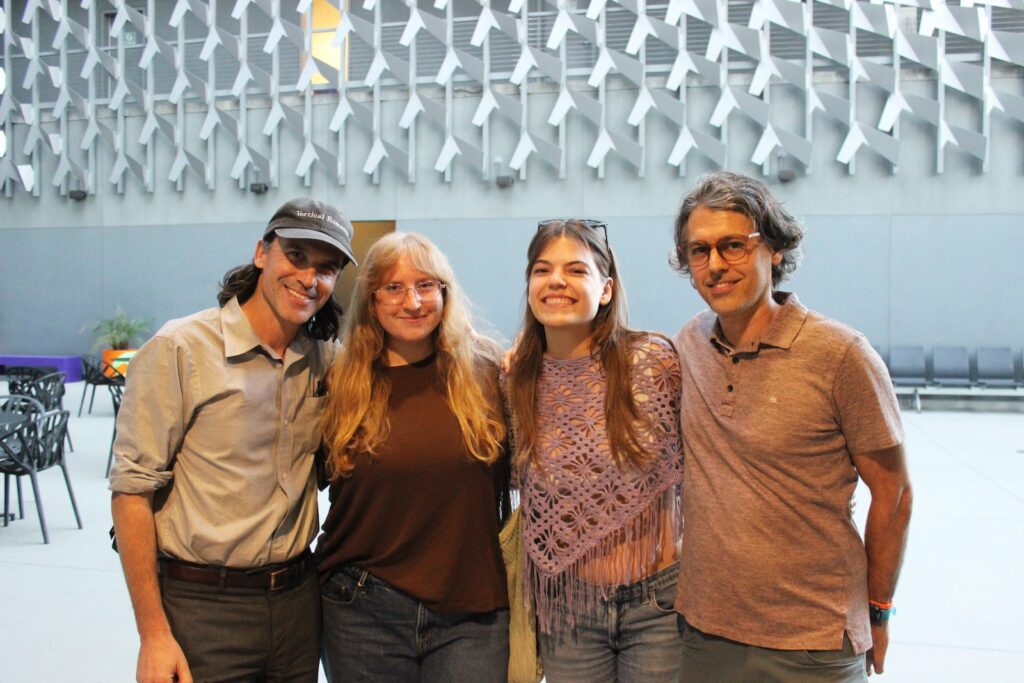
“As interns, we got to work from the development stage, the production stage, the post-production stage,” said Loach, an aspiring screenwriter. “We got to do basically everything because it’s such a small company, but we were moving so quickly. I’d recommend it to everyone.”
Still, the format has its critics. For those who dismiss microdramas as trashy or low art, Reich points to Shakespeare and television, both of which were once considered low art for the masses. Microdramas are continuing to expand and evolve, meeting audiences where they are: on their phones. In doing so, they are opening up new possibilities for storytelling. Semmens and Reich see those possibilities extending to brands and bands.
In May 2026, a 31-episode vertical Reich directed was released by The All-American Rejects, the first major music band to dive into the microdrama format as a promotional tool for their new album Sandbox. Titled The All-American Rejects: Superfan, it’s about a deranged fan who kidnaps the band and forces them to finish and release new music under pressure as a chaotic livestream unfolds. Reich subsequently won Best Director at the Vertical Shorts Festival for the project and the All-American Rejects ended up signing a deal for a sequel.
“In verticals, you can be a trailblazer,” said Reich. “It’s so exciting.”
Reich and Semmens said they both wish the format had been around when they graduated.
“Being on set on a vertical is what I always imagined filmmaking was like,” said Reich. “When I actually entered the film industry… [it was] a lot of [sending] emails and talking and trying to get something made. With verticals, you’re just doing it.”