Armando Barbosa ’28 grew up playing card and board games with his extended family, who would bond over rounds of Tick Tock Boom.
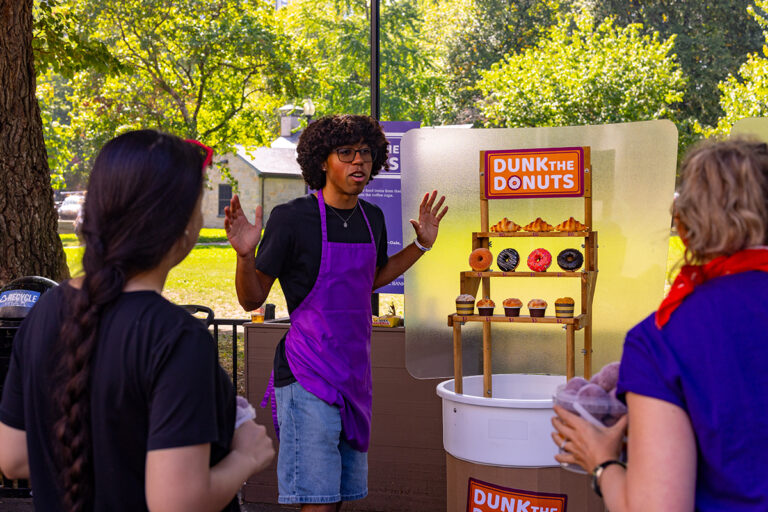
Today, Barbosa is a game designer himself. He and two classmates created Dunk the Donuts, which visitors to the Emerson College UnCommon Corner were able to play earlier this month during the second annual Day of Play, an interactive showcase of games created by Emerson students.
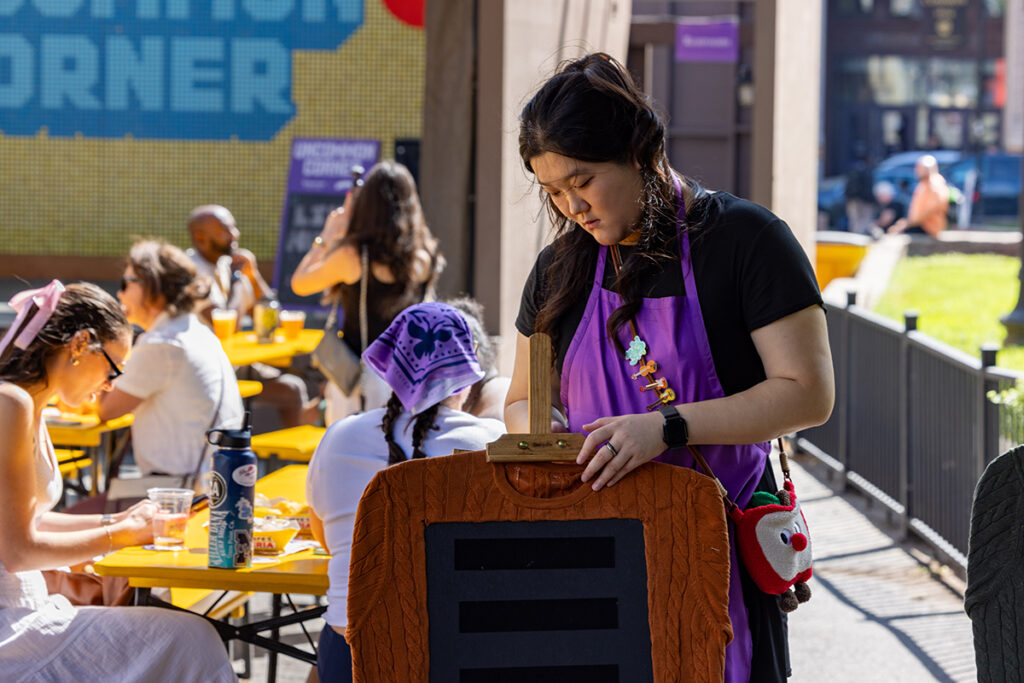
This year, students in Assistant Professor Laurie Mazza’s Spring 2026 Introduction to Game Design class designed the games with the partnership and help of FableVision Games, a Boston-based educational game developer. Games also included Bean Time, a coffee-themed sorting game; Café Quest, a coffee-based scavenger hunt (sense a pattern?); Cozy Grandpa Hipster Sweaters, a memory matching game; and Who’s on Shift?, a social deduction game centered around a restaurant.
In Dunk the Donuts (with apologies to a certain Boston-based multinational fast food chain), players toss plastic donut holes at shelves of fake donuts, muffins, and croissants, trying to knock the breakfast items into a giant coffee cup. There’s a point system based on the type of baked good.
“It’s very similar to Down the Clown, except it’s with pastries,” said Barbosa, a Media Arts Production major who created the game with Takara Bayley-Gale ’28 and Qihao “Anthony” Hong ’27.
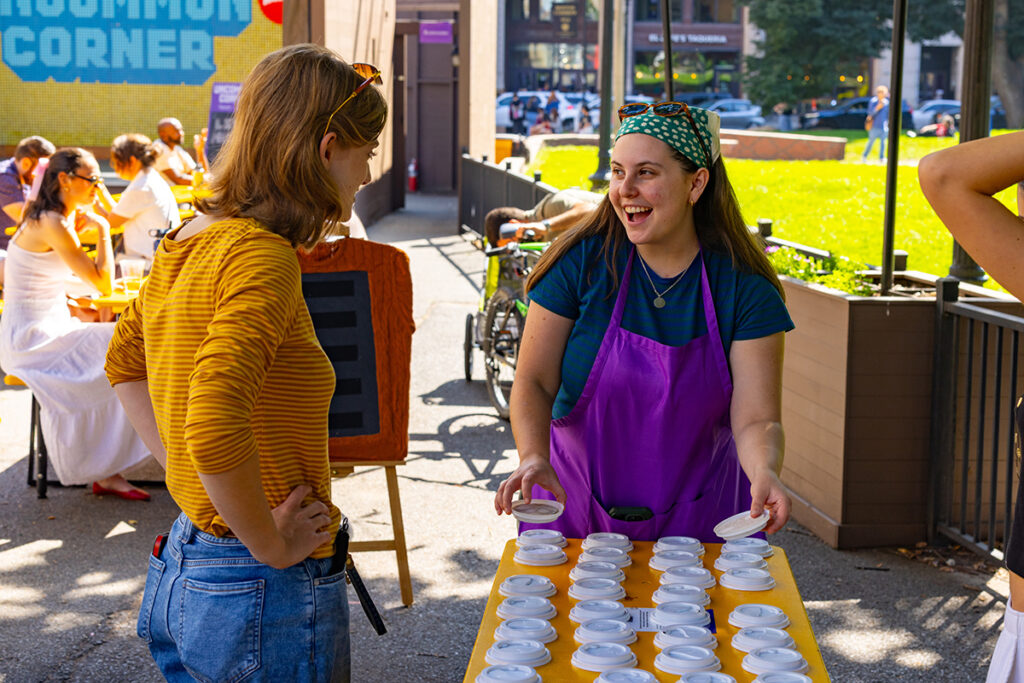
Barbosa and his classmates brought their games to the UnCommon Corner to test them in the wild, but it also was a chance for the students to see their ideas brought to life.
“All of our designs were crudely drawn and made on Google Docs, and then…it’s like, wow, this is a whole board of realistic donuts that we could actually play and knock down and stuff. It’s just really, really cool to be able to see that in person,” he said.
The fact that the class was developing games that would eventually be played by the public raised the stakes for students, who knew whatever they came up with needed to be viable, easily grasped, and fun for all ages, Mazza said.
“People who are just possibly visiting Boston for the first and only time in their lives might walk by and join in, so it’s something bigger than a one-and-done course project,” she said.
Mazza starts by giving students, many of whom have little to no prior game design experience, design limitations. She asks them to take an old (and maybe a bit tired) card game, such as War or Memory, and “fix it” by making it more challenging or interesting. For the classic matching game Memory, some students introduced Joker cards into the mix. The rules of their version said if you draw one of them, you have to shuffle the entire array of cards.
Mazza said she didn’t make it to the end of that particular game, but it did open up a discussion about the function of games in general: Do they have to be fun?
“I’m somebody who wants to spread a little joy in the world, [and] games are a great way to do that, [but] games don’t always have to have the sole purpose of being fun. They can have other experience goals,” Mazza said. “Frustration can be a valid experience goal, [though] maybe not to the person who’s grading you.”
Students also learn to take into consideration things like audience, setting, and age group.
“One design challenge that I love to give them is [to] start with who’s going to be playing it. How do you make a good game for them?” Mazza said.
The second half of the semester, students break into teams and use the knowledge and skills they developed during the first half to work on developing the games they eventually will unleash on the public. They got help from Kellian Adams Pletcher, FableVision’s director of galleries, libraries, archives, and museums (G.L.A.M.), who talked through the students’ ideas and critiqued their game designs.
For Dunk the Donuts, Pletcher suggested having the pastries fall into a funnel inside a large coffee cup to make clean-up easier for players—or, especially, parents.
“You can tell…when you’re working with a professional [who] gives you great feedback, and you can tell exactly all their experience accumulates into helping us make the games as good as they could be,” Barbosa said.
FableVision also worked with Mazza and the students to create 3D games from their design docs and cardboard prototypes.
Barbosa hoped that young kids, older kids, and adults alike would find something fun in Dunk the Donuts.
“I’m definitely excited for people’s reactions to it, and I’m interested to see how competitive people will get with their friends, because it is a competition,” Barbosa said ahead of Day of Play.
Mazza said that journey—taking something from a germ of an idea (“sometimes a joke idea in your head,”) to a fully formed, tangible experience that can be shared with others— is “incredible,” both for Mazza’s students and for her.
“As somebody who creates things,” Mazza said, “getting to see something that I was like, ‘O.K., this is how this is going to work,’ and then see it actually take form, it’s almost magical.”