Millions of creatives around the world dream of moving to Los Angeles and launching careers in the entertainment industry.
For four decades, Emersonians have had a pathway to make those dreams a very achievable reality, thanks to the Emerson Los Angeles (ELA) program.
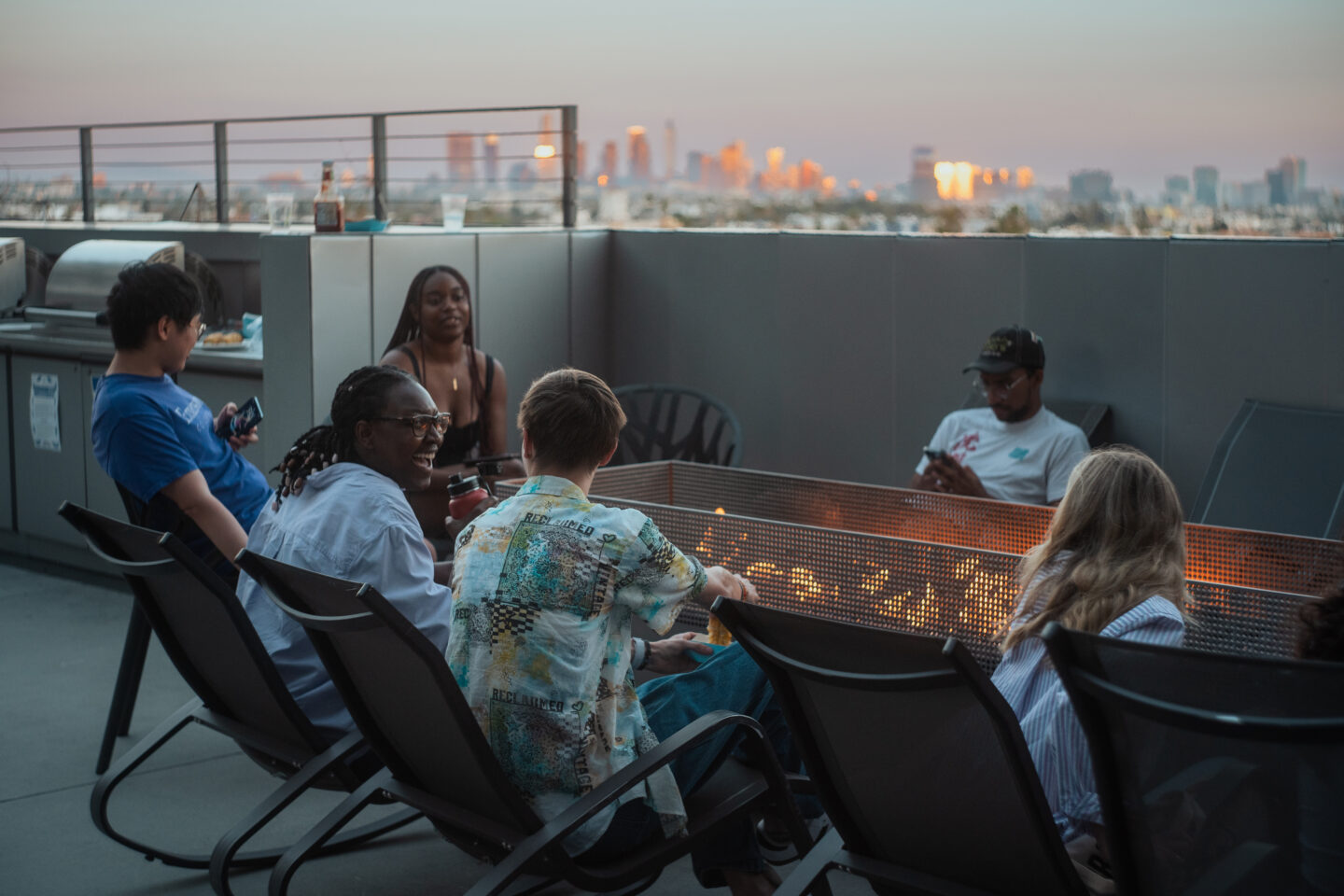
Anchored from a stunning 10-story tower in the heart of Hollywood, ELA offers students the chance to live, study, and work in Los Angeles for a semester.
The guiding principle of the program has always been to give Emersonians the chance to step outside of classrooms where they learn about the entertainment industry, and begin actually working in it before they graduate.
That groundbreaking idea has paid off—not only was ELA the first satellite film and media program of its kind, but it also remains the most successful, said ELA Dean Ken Rogers ’91.
“With the model we pioneered, we have fundamentally changed the way the American film school system works,” he said.
Each week, in addition to taking classes, students intern in industries ranging from film to publishing to politics, taking seats at tables with professionals who have greenlit their favorite movies, helped promote their favorite pop stars, and published their favorite novels.
Over the last four decades, ELA has helped launch thousands of careers, inspired dozens of similar programs at Emerson’s peer institutions, and transformed into a hub where Academy Award-winning filmmakers, television stars, and Emerson alumni alike regularly drop by for events.
Like most creative endeavors, ELA started with an idea.
Going West
The first roots of the ELA program were planted in the early 1980s, when a few Emerson professors began periodically taking students to LA for opportunities like seminars and shows.
In 1986, Gregory Payne, associate professor of the Department of Communication Studies, brought 15 Emersonians to the city for internships tied to California’s gubernatorial campaign. Seeing that group’s success, Alan Koenig, Emerson’s then-president, asked Payne and others to develop an LA program for the College, which included classes in politics, journalism, and television production.
Over the next several years, it continued to grow and evolve, but maintained its focus on students doing hands-on professional work through internships.
Senior Scholar-in-Residence Jim Lane, graduate program director in Emerson’s School of Film, Television, and Media Arts, served as the executive director of ELA from 2001 until 2014. When he began leading the program, it enrolled approximately 80 students per semester, compared to more than 200 now.
During his tenure, the world and the entertainment industry went through several changes. Emerson’s reputation for producing professional and prepared students through its highly specialized curriculum, however, kept ELA’s internship program relevant.
“Emerson College’s name is well known within the entertainment industry,” Lane said, “and internship sites told us constantly that Emerson students are actually well prepared to take internships in the entertainment industry.”
For its first 28 years of existence, ELA was housed in a rented office space in Burbank. Back then, before its 2014 move to the current Sunset Boulevard building, its handful of staff members got used to working together in close quarters.
“It had a smaller, hometown feel to it,” said Jennifer Vandever, a senior affiliated faculty member at ELA who has taught in the program since 2001. “Now that we’re in the larger building…the larger intention of creating the space…was to create a home not just for current faculty, staff, and students, but for alumni and to create this sense of continuity.”
Emmy Award-winning director and producer Kevin Bright ’76, LHD ’11, was instrumental in designing and establishing ELA’s permanent home on Sunset Boulevard.
Bright, a former Emerson Trustee, artist-in-residence, and longtime faculty advisor, was named the founding director of Emerson Los Angeles when the Sunset campus opened in 2014.
Regardless of its location over the years, ELA has always given students the unique opportunity to learn about subjects like film and media in the very place where many of the works they study were created.
In Vandever’s screwball comedy class, for instance, she points out that one of the most defining movies of the genre, It Happened One Night, was shot near her classroom.
“You have this sense of being in this cradle of old Hollywood that’s now evolving into new Hollywood, with Netflix down the street,” she said.
Students can also take courses about the culture, environment, and history of LA, such as Senior Affiliated Faculty member Paul Mandelbaum’s class on the literature of Los Angeles.
“I figured students are coming out here with little awareness of what LA is like. It’s a very different place from where many of them are coming from,” he said, “and they may find it interesting, and even reassuring, that many authors and content creators have been pondering these same histories for a long time.”
Evolving as the World Does
ELA’s emphasis on hands-on learning through internships, Lane said, has been incredibly helpful in preparing students for a career in an industry that doesn’t offer one traditional track to climb the ranks like other fields, such as healthcare, do.
“This particular industry has to have its finger on the pulse of what’s popular at any given moment…it tends to react very quickly and change very quickly,” he said, “so as a result, a program like Emerson LA keeps the students in tune with that.”
In that same vein, many ELA faculty members only teach in the program part-time, and spend the rest of their days working in Hollywood as screenwriters, directors, and producers. Their proximity to the industry allows students to learn about what working in the current iteration of entertainment and media is like directly from them.
For Journalism major Meghan Boucher ’27, interning at a music public relations firm this semester has helped her understand the relationship between artists and the press in an evolving media landscape.
“Being able to understand how it’s changing across different industries is definitely important, because it makes you a better journalist and more able to adapt to whatever situation you might find yourself in postgrad,” she said.
Andrew Kogan ’27, a Media Arts Production major, is interning at Red Wagon Entertainment, a production company founded by the producers behind Girl Interrupted, Gladiator and its sequel, and the Stuart Little films.
Kogan spends most of his internship reading scripts, and looking for unique submissions that are well written, match the company’s brand voice, and are relevant to today’s world. The gig has taught him a lot about how competitive screenwriting is, he said, and what makes a script stand out.
ELA has also allowed him to get a feel for living and working in Los Angeles with a built-in community alongside him.
“This feels like the easiest way to figure out what living in LA is like while still having some sort of safety net,” he said. “…I really do feel like the ELA program is a good stepping stone from the college, academic experience into postgrad life.”
And as the rise of AI, social media, streaming, and other disruptors of traditional media and audience behavior continues, the ELA program has plans to continue its expansion and evolution with the industry.
Today, Rogers envisions Emerson Los Angeles as the premier industry-integrated learning environment in higher education. He envisions a place where academic innovation, professional development, and industry engagement are unified.
Through new programming around video podcasting and other forms of emerging media, ELA has plans to help its students engage even more deeply with the entertainment and media industry in Los Angeles, said Rogers.
One example of that is a new pilot program called Thursdays on Sunset, where small cohorts of ELA students come together weekly to hear from industry speakers, engage in professional development, and meet with ELA alumni through Emerson’s Career Advisory Network (CAN).
Looking ahead, through expanded curriculum offerings, more alumni engagement, and industry-facing events, the program aims to act as an even stronger conduit between students and the entertainment industry, rather than just giving them proximity to it.
“Ultimately, we’re not trying to train students for a fixed version of the entertainment industry as it exists today,” Rogers said, “We’re trying to prepare them to enter an industry that will continue changing throughout their careers—to give them the professional fluency, adaptability, relationships, and confidence to evolve along with it.”