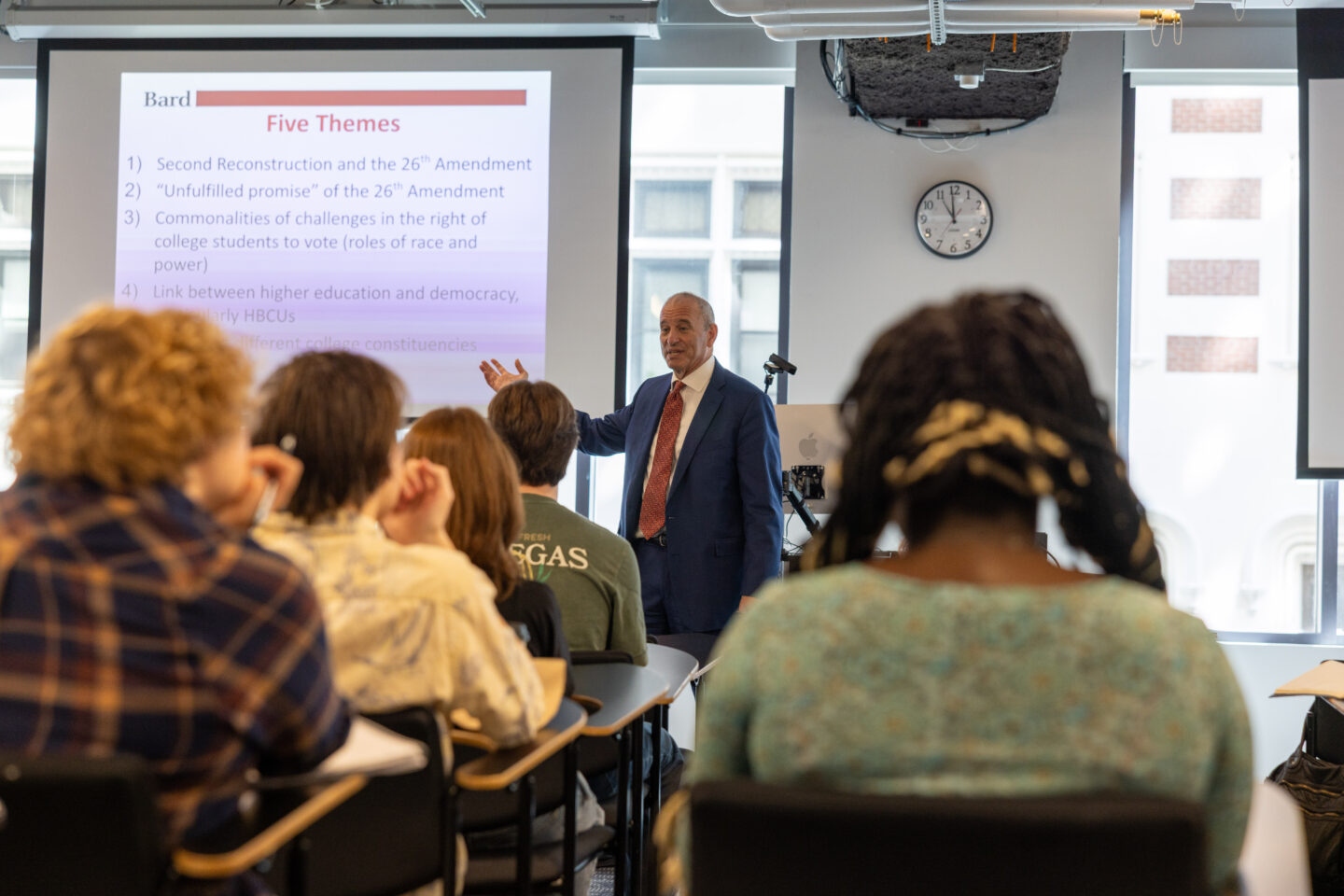
When people think of voter discrimination, they don’t usually think of ageism. The systematic disenfranchisement of college students across the country often falls under the radar. Emerson College made sure it was part of the conversation this Constitution Day to help prepare for the upcoming midterm election.
Jonathan Becker, the acting president of Bard College and a professor of political studies, joined Emerson students in the Little Building on September 17 to discuss the importance of voting, especially for young adults.
With the SAVE Act currently stalled in the Senate, this upcoming election has major implications for the future of voting rights. The strict identification requirements outlined in this act have the potential to disenfranchise tens of millions of American citizens, including many Emerson students. Voting in this election means protecting the right to vote in the future.
“If you vote when you’re young, you vote throughout the rest of your life,” said Becker, who recently authored Youth Voting Rights: Civil Rights, the Twenty-Sixth Amendment, and the Fight for American Democracy on College Campuses.
During his visit to Emerson, he walked the room through the history of the Second Reconstruction, beginning with Brown vs. Board of Education in 1954 and making his way to the ratification of the 26th Amendment in 1971, which lowered the voting age from 21 to 18. But securing the right to vote wasn’t the end of the journey.
“Some of the systems used to exclude African Americans [from voting] have been used on young people,” Becker said. From gerrymandering to targeted eligibility forms to inaccessible poll locations, local and state governments have tried to keep college voters from influencing election results.
“Many of the most conflictual moments happened just when there was intense political competition,” Becker said, “and at those moments, the targeting of young people grew.”

Becker said that pattern is occurring again in the United States today as the rates of political polarization continue to rise.
“Be organized,” Becker told the students. “If you’re voting absentee, you need to be on top of it because it’s a very difficult process, and it is under assault right now.”
He continued: “If you don’t know what your state deadline is, go to vote.org. There’s a number of things that you can find out — when you have to apply for an absentee ballot, when you have to fill it out, and how you go about that.” He also warned students that about 50% of paper ballots get disqualified for minor reasons, even something as innocuous as a smudge. “So, when you’re doing your absentee ballots,” Becker said, “be careful.”
For more information, Emerson offers a number of resources to assist students with the registration and voting process as well:
- The Hub: A voter registration page can be found on the Hub with information on how to register in Massachusetts. It also provides links to similar resources for out-of-state voters.
- Emerson Votes: Located on the Iwasaki Library website, Emerson Votes guides students through the entire voting process. Some notable features include:
A: Voting Plan Templates with checklists for students who want to track their progress
B: A Find your State section with a page for each of the 50 states, as well as the District of Columbia, outlining the different requirements to register, request a ballot, and vote
C: A list of notaries on campus for states that require this step