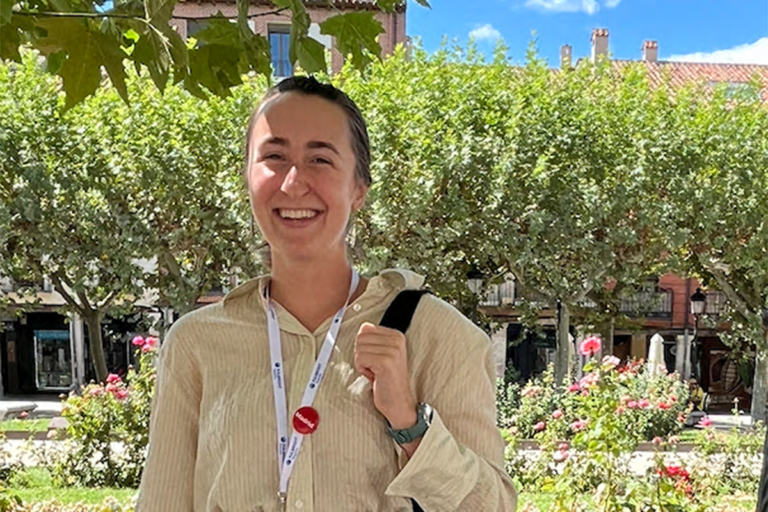
Katherine Holmes, MFA ’26, is spending this academic year in Spain on an English Teaching Assistant (ETA) Award, using her graduate degree in Creative Writing to help students at IE University with their writing projects.
The grant, administered through the Fulbright Program and awarded to only 167 recent graduates nationwide, provides Holmes with a teaching preparatory course and a mid-year seminar, in addition to a stipend, medical insurance, and round-trip airfare.
We asked Holmes about the kind of work she’ll be doing, what she hopes to learn, and how Emerson set her up for success in another country.
Where and what are you teaching this year?
[I’m] working in Madrid as a writing consultant at the IE University Writing Center. IE is…about 70 percent international students. The position includes a possible teaching assistantship, one-off panels, and conversation practice with university staff. The Writing Center’s primary visitors are college freshmen in the fall, and upperclassmen with major projects and theses in the spring.
What drew you to apply for the ETA? Are you interested in teaching once you’re back in the U.S.?
I wanted to combine work and travel, furthering my teaching and writing practices in a foreign-language context, and in a country that I love.
I studied abroad in Barcelona my sophomore year of college, and traveled through the south of Spain the following year, and I wanted to not only immerse myself more deeply in Spanish culture by living and working in Spain, but also improve my Spanish and explore translingual creative writing. I’d love to continue teaching once back in the U.S. and apply my experiences in Spain to the American classroom.
What do you hope to learn from the experience?
I hope to learn about different pedagogies and solutions for today’s students; gain life lessons and priceless memories through travel experiences (especially living as an outsider and grappling with cultural and linguistic nuances); expand my creative repertoire and challenge my way of seeing the world; and become a contributing member of my community at IE and my neighborhood, Tetuán.
What are you most excited about?
I’m excited to connect with locals and learn more about the Guerra Civil and the Móvida Madrileña. My Fulbright side project is a collection of translingual short stories informed by research and interviews, which I’m hoping to conduct on the fly and by partnering with a local senior living facility or community center.
I’m also excited to dig into Madrid’s various neighborhoods, attend literary events in the Barrio de las Letras, and expand outward to other parts of Spain that I haven’t seen before, like Galicia and País Vasco.
Do you plan to work on your own writing while you’re over there?
Yes, I very much plan to work on my own writing — both the second half of my Emerson thesis and the collection of translingual short forms that I’m proposing for my side project. In any case, you can’t travel and not write about it!
How has Emerson prepared you to live and work in another country?
My involvement in [Writing, Literature and Publishing] has definitely prepared me to live and work in another country. Knowing how to network, plan events, balance work/study/life, and troubleshoot various problems or conflicts are essential for not only preparing to move abroad, but also navigating the housing search and immigration system, connecting with colleagues, and making the most of the grant. Any experience that continually challenges you to self-start, connect, and adapt is invaluable.
It’s worth noting, too, that completing the Fulbright application itself can help to prepare you. The application calls on many organizational skills and requires a fair amount of self-reflection on why you want to live and work in another country.
Lastly — and there’s no hack or bypass for this one — growing older and becoming more settled in your personality, knowing what you want in life, and maturing out of self-consciousness and insecurity, helps tremendously.