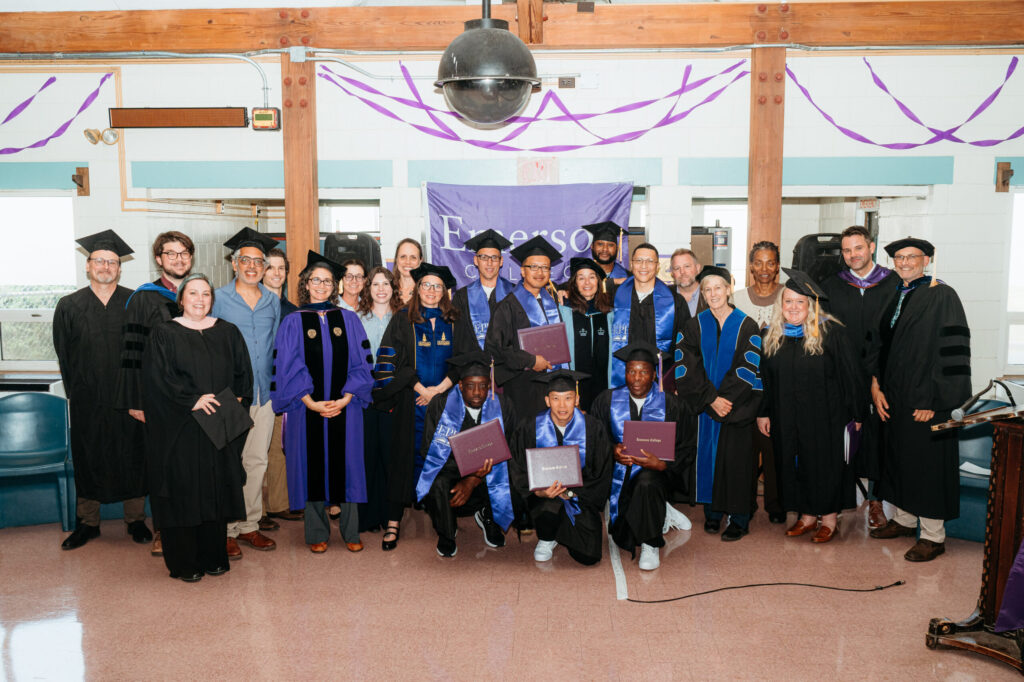
The Emerson Prison Initiative (EPI) has received a three-year, $500,000 grant from the Mellon Foundation that will fund the state’s only graduate certificate program in prison. Beginning in January 2027, the Graduate Certificate in Communication and Social Practice will be offered to 15 students at the Massachusetts Correctional Institution at Norfolk who have previously obtained their bachelor’s degrees.
“This grant comes at a pivotal moment in EPI’s history as interest in these life changing programs increases,” said Jay M. Bernhardt, President of Emerson College. “These funds will allow the EPI program to launch the state’s only graduate certificate program that will provide new opportunities for incarcerated students to maximize their potential.”
Since it began in 2017, the Emerson Prison Initiative has admitted 80 people incarcerated at MCI-Concord and now, MCI-Norfolk, into their higher education in prison program, and nearly 20 of them have earned bachelor’s degrees. Two students who began with EPI have also completed their degrees on the Boston campus, with a third student scheduled to graduate in December, and another who recently completed his degree at Columbia University after time in both EPI and on the Boston campus.
EPI offers the same courses taught on Emerson’s Boston campus, taught by Emerson faculty as well as guest faculty from other local universities, all bearing official Emerson credits. Each cycle, the program selects students through a rigorous admissions process that includes in-person interviews and an essay exam scored by a faculty panel, leading to approximately 25 percent of applicants being accepted. Early next year, EPI will run admissions for its fifth cohort of 20 bachelor’s degree students who will begin their studies in fall 2027.
During EPI’s nearly decade-long existence, many graduates and their families have called the initiative life-changing, but also expressed frustration at being unable to continue their educational pursuits further while incarcerated, said Mneesha Gellman, founder and director of EPI.
EPI runs a peer tutoring program that offers bachelor’s degree recipients the opportunity to become academic tutors for current undergraduates. However, that initiative doesn’t give graduates an additional academic credential, which Gellman said many desire after receiving their bachelor’s degrees.
“They have become hungry learners as undergraduates, who want to keep learning, but what opportunities remain for them post-commencement?” she said, “This is one way we are making a path to ongoing educational opportunities.”
The decision to focus EPI’s graduate certificate on Communication and Social Practice, Gellman said, was made with Emerson’s institutional strengths in mind, and also because the subject matter offers graduates versatile skills that can be applied across many fields. Gellman will be teaching the program’s first course beginning in January, which will cover research methods and writing, skills she called a “key toolkit” for the foundation of the graduate certificate.
“When I think about Emerson and its identity as an institution, of course communication is at the forefront of that, but it’s practiced in a really interdisciplinary way, and also cross-disciplinarily” she said. Applying communication and social practice both academically and in real world situations can serve both the professional and personal goals of graduate cohorts in the coming years.”
The grant from the Mellon Foundation will also support strengthening EPI’s administrative and organizational infrastructure, piloting and evaluating wellness programs for prison staff and returning citizens, and evaluating the pilot graduate certificate program to inform future graduate programming.
Some wellness programs that EPI has run over the years, Gellman said, have included offering workshops on topics such as writing college essays and navigating financial aid for correctional staff and their families, who are themselves subject to different forms of educational inequality.
EPI also recently facilitated a four-part financial literacy workshop for formerly incarcerated people. “For us, that is integral to wellness,” she said, “because if people are dealing with financial scarcity or financial insecurity and they’re not sure how to navigate their financial landscape, it impacts one’s mental health.”
Studies have shown that college-in-prison can interrupt cycles of incarceration and contribute to personal and communal transformation. Many EPI graduates, Gellman said, have put their degrees to use directly after being released from prison.
Some have led violence intervention work in the Greater Boston area, for instance, including by going into juvenile detention centers to work with young people there on how to make different life choices. Many EPI graduates’ relatives, she added, have also been inspired to continue their education after watching their loved one persevere in college in such adverse circumstances.
“Those are the kinds of experiences where we really see the impact of a college education,” she said, “and that drives us to continue to be the best program that we can be, including through this expansion.”
Gellman’s ultimate goal for EPI, she said, is that the success of this pilot program will eventually lead to offering incarcerated students the opportunity to pursue a Master’s degree. In the meantime, she is proud of this important expansion of the program, and hopes it will inspire other educational institutions to create similar initiatives at prisons across the country.
“We recognize that this is an opportunity for Emerson to continue its excellence in a space where access to education is so needed and yet so limited,” she said, “and I am proud of my colleagues and institution for the hard work and leadership in education in prison.”