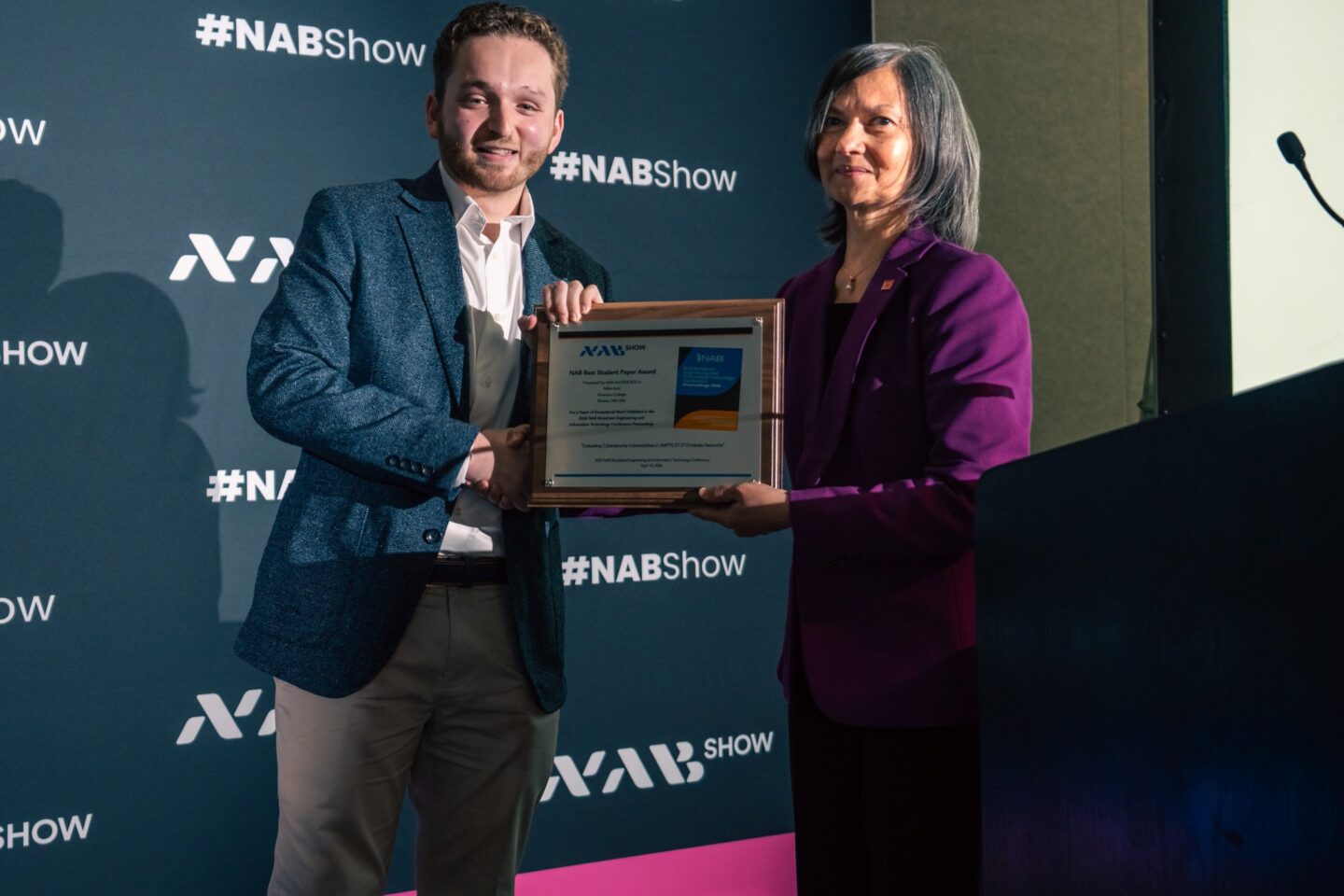
When Miles Katz ’26 stepped onto the stage at the National Association of Broadcasters (NAB) Broadcast Engineering and IT Conference in Las Vegas this spring, he wasn’t just accepting an award—he was presenting research to many of the engineers who helped shape the technology he was studying.
Katz, a School of Film, Television, and Media Arts major, received the Best Student Paper Award for his research examining cybersecurity vulnerabilities. He looked at weaknesses in SMPTE ST 2110, which is a set of digital standards that lets TV stations send video, audio, and data separately over computer network cables instead of old-fashioned heavy cords.
His interest in the topic was piqued at Emerson. “It all started at Tufte,” Katz said. “When those doors opened, it got me inspired.”
Research Inspired by Real-World Experience
Rather than simply identifying potential weaknesses, Katz set out to better understand how cybersecurity should be incorporated into an increasingly connected broadcast industry.
“With SDI, you plugged in a cable and it worked. You couldn’t really hack a wire,” said Katz. “Now we’re working in IT, and broadcast engineers and IT networking [teams] are having to learn each other’s worlds.”
Katz’s research grew out of the hands-on engineering experience he gained as a student technician in Emerson’s Tufte Performance and Production Center.
He began working in the television studios’ control rooms before moving into the central machine room, where he helped maintain the video routing and technical infrastructure that powers productions throughout the facility.
An internship at NBC introduced him to ST 2110 technology, which the company was beginning to implement. Curious about what adopting the standard might look like at Emerson, Katz worked with Media Technologies and Production (MTP) Director of Production Facilities Tony Ascenso ’00, MA ’20, on an independent study exploring how the College’s existing broadcast infrastructure could transition to the newer system.
That project sparked an even bigger question: If broadcast facilities are becoming computer networks, what new cybersecurity risks come with them?
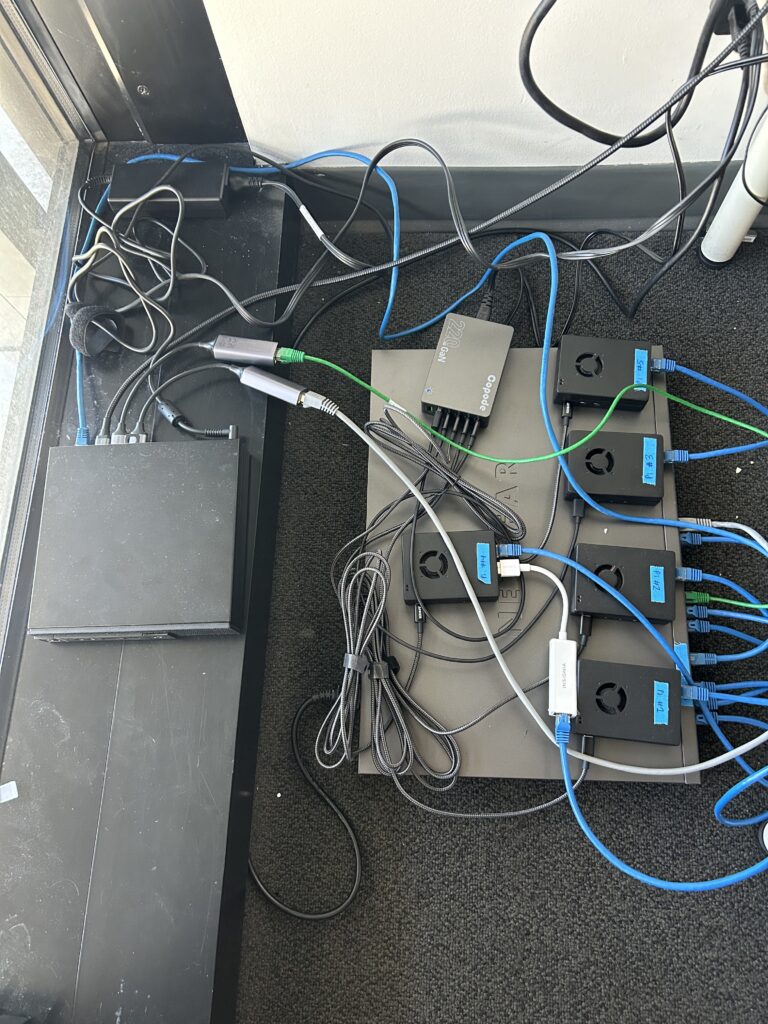
To find out, Katz reached out to Emerson alumni and broadcast engineers working throughout the industry to better understand their concerns. Then, while studying at Emerson Los Angeles, he built his own miniature testing lab on his dorm room floor using Raspberry Pi computers, a network switch, and a Dell PC.
“I would attack the system in my dorm room,” he said with a laugh.
Professional ST 2110 equipment costs a lot more than $100,000, so Katz focused on testing the principles behind the protocol rather than recreating a full broadcast facility. Across eight experiments, he identified several potential vulnerabilities and proposed areas for future research, including stronger authentication methods within the protocol.
“The standard wasn’t really designed with cybersecurity in mind,” he said. “It’s something that’s been overlooked as the industry transitions into IP networking.”
That led him to writing his award-winning paper.
The NAB honor earned Katz funding to travel to Las Vegas, where he presented his findings before an audience of broadcast engineers, industry leaders, and several of the developers who helped create the ST 2110 standard.
The same paper has also been recognized by the Society of Motion Picture and Television Engineers (SMPTE), earning a student paper award at the organization’s upcoming Media Technology Summit this November, where it will be published in the SMPTE Motion Imaging Journal.
Katz recalled presenting at NAB to be a little nerve-wracking. “The people who wrote the ST 2110 standard were sitting in the audience. My bosses from NBC were there. People from Emerson were there. It was definitely daunting,” he said.
From Emerson to NBC Sports
Katz’s engineering expertise has already translated into a career.
After internships with NBC’s Washington, D.C., political bureau and later with NBC’s systems architecture team at 30 Rockefeller Plaza, Katz now works full-time as a Production Engineer at NBC Sports in Stamford, CT.
He helps maintain the technical infrastructure that supports major broadcasts, including Sunday Night Football and the Tour de France, ensuring control rooms and broadcast systems operate reliably.
“I’d love to go into systems design and systems architecture,” Katz said. “I’d also like to help develop future broadcast standards.”
Building an Engineering Foundation at Emerson
While Katz credits his internships for exposing him to emerging broadcast technologies, he says the foundation was built at Emerson.
As a student, he served as a studio staff technician in Tufte, worked as a technical manager and engineer for the EVVY Awards, and gained extensive experience troubleshooting broadcast systems and configuring professional production equipment.
“I fell in love with the technical aspect of production at Emerson,” he said. “Understanding how all of the systems work—that’s what Tufte taught me.”
He also credits several mentors for helping shape his career, including Ascenso, MTP Technical Manager Zac Persechini, MTP Assistant Manager Owen Conti ’22, and MTP Paramount Soundstage Manager Travis Trudell.
“Tony’s independent study was amazing,” Katz said. “Those four people were foundational. They taught me about workflows and how to be a professional.”
Ascenso was impressed that Katz took a technology standard used across all major networks and found vulnerabilities using only basic tools.
“As technology evolves so quickly, the industry needs people with the passion and attention to detail required to ensure those systems remain reliable and secure. It’s rare to see someone young dive so quickly into this field,” said Ascenso.
Looking back, Katz believes Emerson’s Tufte Television Studios are one of the College’s gems.
“I think the Tufte engineering side of Emerson is a hidden gem,” he said. “When I went out into the industry, people were looking for technical people. Without the facilities and the opportunities at Emerson, I wouldn’t be anywhere close to where I am today.”