When Kenan Orhan, MFA ’17, arrived at Emerson College, he believed there was only one way to become a serious writer.
“I thought you had to write like Ernest Hemingway. I thought you had to be very to the point,” he said, adding that he even took up boxing as an undergraduate in an effort to emulate the famed author.
But all that changed at Emerson.
Through classes with Writing, Literature and Publishing Professor Emeriti Steve Yarbrough and Pablo Medina—and through conversations with a talented cohort of fellow writers—Orhan discovered that literature is expansive, playful, and experimental.
“I came thinking Ernest Hemingway was the only way to write,” said the Turkish-American author. “I left, fortunately, with an appreciation for all forms of literature.”
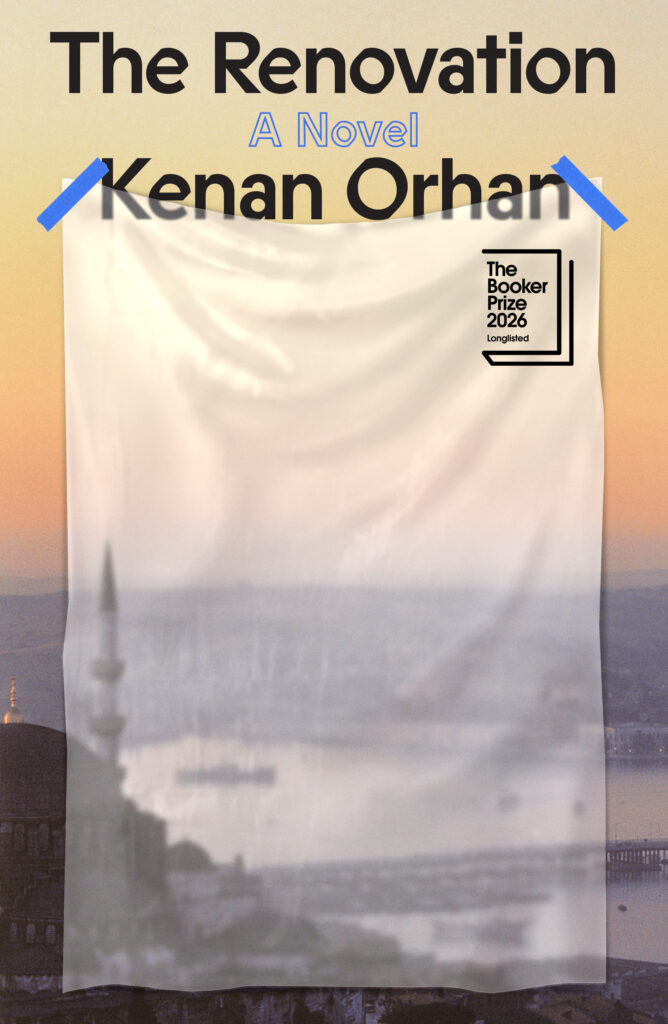
Nearly a decade later, that broadened perspective has helped propel Orhan onto one of literature’s biggest stages. His novel The Renovation was one of 10 novels longlisted for the National Book Award for Fiction, considered one of the most prestigious literary achievements. It was also one of 13 novels longlisted for the Booker Prize, one of the world’s highest honors for fiction written in English. The Booker Prize shortlist will whittle it down to six novels on September 22 and the winner will be announced at a ceremony in London on November 9. The National Book Award finalists will be revealed on October 6 and the winner will be announced on November 18.
“It’s been surreal,” Orhan said in August, after learning about the Booker Prize nomination. “These experiences feel like a dream, which is what I aim for in my writing. It’s been a nice tandem experience.”The recent announcement has brought an outpouring of support from readers and fellow writers—and unexpected attention from his family’s homeland.
“I was surprised by how many interview requests came from Turkey,” he said. “It’s been really cool to see the support and people reaching out with nice words. Writing is such a solitary field.”
For Orhan, the recognition carried an emotional weight beyond the honor itself.
“It was really difficult to breathe,” he said, describing what it was like when he learned he’d made the longlist. “I kept kind of choking on relief.”
Orhan has balanced his creative ambitions with financial uncertainty. He previously taught creative writing for several years at the Kansas City Art Institute, but stepped away because it left less time for his own work. The Booker recognition, he said, has already eased years of anxiety. He said that since being longlisted, there’s been a greater demand for his book in the United Kingdom, and that more copies were already being printed.
The Renovation is Orhan’s second book. His first, I Am My Country and Other Stories, was a finalist for the PEN/Robert W. Bingham Prize and longlisted for The Story Prize. His fiction has appeared in The Atlantic, The Paris Review, McSweeney’s Quarterly, The O. Henry Prize Stories, and The Best American Short Stories.
Surrealism Instills Real Confidence
At Emerson, one class with Yarbrough in particular challenged nearly everything Orhan believed about storytelling. In the workshop, he encountered stories that abandoned realism in favor of imaginative, unconventional narratives.
“It just shook me out of my mindset,” he said. “You could be emotionally moving without being emotionally constrained.”
Another course taught by Medina—Writer, Demon, Craftsman—further expanded Orhan’s literary horizons, introducing him to novels and poetry from around the world.
“It created this sense of exploration,” he said. “The professors taught in ways that really jived with the way I learn.”
Just as important were the classmates who became lifelong friends.
“We’d go out after class and sit for another two hours talking about books,” he said. “I’m still friends with six or seven people from my cohort. We chat every day. That’s been enormously helpful.”
Those conversations also fueled Orhan’s growing fascination with fabulism, surrealism, and literature that blurs the line between reality and imagination.
That influence is evident throughout The Renovation, which has a central premise as startling as it is symbolic: a woman discovers that her bathroom has been remodeled into a prison cell mirroring a real-life Istanbul prison.
“The subconscious works in really interesting ways,” Orhan said.
The story emerged after years spent reading memoirs and poetry written by imprisoned and formerly imprisoned Turkish authors while reflecting on political upheaval in Turkey, including the devastating 2023 earthquakes and a contentious national election.
Then, one night, the opening line arrived unexpectedly.
“I woke up in the middle of the night with a strange voice saying the first line over and over,” he recalled.
While the prison initially appears to function as a metaphor for political exile, Orhan intentionally layers the story with additional meanings.
“I’m interested in giving readers something obvious to latch onto and then introducing other interpretations,” he said.
Among those is the emotional reality of caregiving. The novel explores the burdens of caring for an aging loved one, suggesting that both caregiver and patient can experience forms of confinement.
“The human element is what makes stories worthwhile,” Orhan said.
Many of the book’s themes draw from Orhan’s own experience growing up between cultures.
Born to a Turkish family in suburban Kansas, he spent much of his childhood traveling to Turkey before political unrest and personal circumstances kept him away for nearly a decade.
“I became fascinated by what you lose when you leave a place and what you gain when you enter another,” he said. “If place is such a big part of someone’s identity, how much of you is left when you leave?”
Although he writes exclusively in English, Orhan remains deeply connected to Turkey through family, literature, and memory.
Today, Orhan approaches writing with the discipline of a full-time profession. His mornings are devoted to reading and writing, and he still drafts the first third of every project by hand before moving to a computer.
Handwriting, he said, forces him to slow down and naturally becomes an early round of revisions.
Just days before learning his novel had made the Booker longlist, Orhan completed the first draft of his next novel.
Since then, writing has temporarily taken a back seat.
“I’ve done nothing for three weeks,” he said with a laugh. “I’ve just been trying to live in the moment.”